手动流配置
目标
在此示例中,我们演示了流识别、流分割、流合并、流编码和流解码的手动配置,以实现所需的流冗余。
INET version: 4.4
Source files location: inet/showcases/tsn/framereplication/manualconfiguration
模型
在此配置中,我们采用了IEEE 802.1CB修正案中提到的网络拓扑。网络包含一个源节点和目标节点,其中源节点通过五个交换机发送冗余数据流。该流在三个交换机中复制,并在两个交换机中合并。
网络如下:
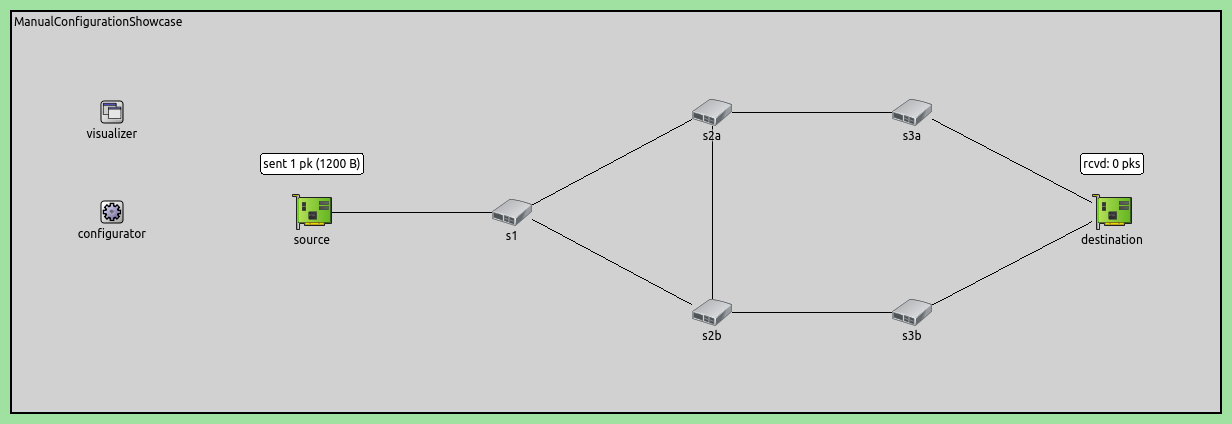
配置如下:
[General]
network = ManualConfigurationShowcase
sim-time-limit = 0.1s
description = "Manual static stream redundancy configuration"

# disable automatic MAC forwarding table configuration
*.macForwardingTableConfigurator.typename = ""

# all Ethernet interfaces have 100 Mbps speed
*.*.eth[*].bitrate = 100Mbps

# decrease throughput measurement interval
**.throughput.interval = 10ms

# link breaks between switches
# 设置链路故障
*.scenarioManager.script = xml("<scenario> \
                                <at t='0.1'> \
                                   <disconnect src-module='s1' dest-module='s2a'/> \
                                </at> \
                                <at t='0.2'> \
                                   <disconnect src-module='s2b' dest-module='s3b'/> \
                                </at> \
                                </scenario>")

# enable frame replication and elimination
*.*.hasStreamRedundancy = true
# source application
*.source.numApps = 1
*.source.app[0].typename = "UdpSourceApp"
*.source.app[0].io.destAddress = "destination"
*.source.app[0].io.destPort = 1000
*.source.app[0].source.displayStringTextFormat = "sent %p pk (%l)"
*.source.app[0].source.packetLength = 1200B
*.source.app[0].source.productionInterval = truncnormal(100us,50us)
# destination application
*.destination.numApps = 1
*.destination.app[0].typename = "UdpSinkApp"
*.destination.app[0].io.localPort = 1000
# all interfaces must have the same address to accept packets from all streams
# 接收端有两个网卡,需要将两个网卡设置为相同的MAC地址
*.destination.eth[*].address = "0A-AA-12-34-56-78"
# visualizer
*.visualizer.infoVisualizer.modules = "*.source.app[0].source or *.destination.app[0].sink"
# configure all egress traffic as part of stream s1, start sequence numbering
# CB是基于报文序列编号进行复制与消除的
*.source.bridging.streamIdentifier.identifier.mapping = [{packetFilter: "*", stream: "s1", sequenceNumbering: true}]
# encode egress stream s1 to VLAN 1
*.source.bridging.streamCoder.encoder.mapping = [{stream: "s1", vlan: 1}]
# map destination MAC address and VLAN pairs to network interfaces
*.s1.macTable.forwardingTable = [{address: "destination", vlan: 1, interface: "eth0"},
                                {address: "destination", vlan: 2, interface: "eth1"}]
# allow ingress traffic from VLAN 1
*.s1.ieee8021q.qTagHeaderChecker.vlanIdFilter = [1]
# enable stream policing in layer 2 bridging
*.s1.bridging.streamRelay.typename = "StreamRelayLayer"
*.s1.bridging.streamCoder.typename = "StreamCoderLayer"
# map eth2 VLAN 1 to stream s1
*.s1.bridging.streamCoder.decoder.mapping = [{interface: "eth2", vlan: 1, stream: "s1"}]
# eliminate duplicates from stream s1
*.s1.bridging.streamRelay.merger.mapping = {s1: "s1"}
# split stream s1 into s2a and s2b
*.s1.bridging.streamRelay.splitter.mapping = {s1: ["s2a", "s2b"]}
# map stream s2a to VLAN 1 and s2b to VLAN 2
*.s1.bridging.streamCoder.encoder.mapping = [{stream: "s2a", vlan: 1},
                                            {stream: "s2b", vlan: 2}]
# map destination MAC address and VLAN pairs to network interfaces
*.s2a.macTable.forwardingTable = [{address: "destination", vlan: 1, interface: "eth0"},
                                {address: "destination", vlan: 2, interface: "eth1"}]
# allow ingress traffic from VLAN 1 and 2
*.s2a.ieee8021q.qTagHeaderChecker.vlanIdFilter = [1, 2]
# enable stream policing in layer 2 bridging
*.s2a.bridging.streamRelay.typename = "StreamRelayLayer"
*.s2a.bridging.streamCoder.typename = "StreamCoderLayer"
# map eth2 VLAN 1 to stream s2a and eth1 VLAN 2 to stream s2b-s2a
*.s2a.bridging.streamCoder.decoder.mapping = [{interface: "eth2", vlan: 1, stream: "s2a"},
                                            {interface: "eth1", vlan: 2, stream: "s2b-s2a"}]
# merge streams s2a and s2b-s2a in into s3a
*.s2a.bridging.streamRelay.merger.mapping = {s2a: "s3a", "s2b-s2a": "s3a"}
# split stream s2a into s3a and s2b
*.s2a.bridging.streamRelay.splitter.mapping = {s3a: ["s3a", "s2b"]}
# map stream s3a to VLAN 1 and s2b to VLAN 2
*.s2a.bridging.streamCoder.encoder.mapping = [{stream: "s3a", vlan: 1},
                                            {stream: "s2b", vlan: 2}]
# map destination MAC address and VLAN pairs to network interfaces
*.s2b.macTable.forwardingTable = [{address: "destination", vlan: 1, interface: "eth0"},
                                {address: "destination", vlan: 2, interface: "eth1"}]
# allow ingress traffic from VLAN 1 and 2
*.s2b.ieee8021q.qTagHeaderChecker.vlanIdFilter = [1, 2]
# enable stream policing in layer 2 bridging
*.s2b.bridging.streamRelay.typename = "StreamRelayLayer"
*.s2b.bridging.streamCoder.typename = "StreamCoderLayer"
# map eth2 VLAN 2 to stream s2b and eth1 VLAN 1 to stream s2a-s2b
*.s2b.bridging.streamCoder.decoder.mapping = [{interface: "eth2", vlan: 2, stream: "s2b"},
                                            {interface: "eth1", vlan: 2, stream: "s2a-s2b"}]
# merge streams s2b and s2a-s2b in into s3b
*.s2b.bridging.streamRelay.merger.mapping = {s2b: "s3b", "s2a-s2b": "s3b"}
# split stream s2b into s3b and s2a
*.s2b.bridging.streamRelay.splitter.mapping = {s3b: ["s3b", "s2a"]}
# stream s3a maps to VLAN 1 and s2a to VLAN 2
*.s2b.bridging.streamCoder.encoder.mapping = [{stream: "s3b", vlan: 1},
                                            {stream: "s2a", vlan: 2}]
# map destination MAC address and VLAN pairs to network interfaces
*.s3a.macTable.forwardingTable = [{address: "destination", vlan: 1, interface: "eth0"}]
# map eth1 VLAN 1 to stream s3a
*.s3a.bridging.streamCoder.decoder.mapping = [{interface: "eth1", vlan: 1, stream: "s3a"}]
# stream s3a maps to VLAN 1
*.s3a.bridging.streamCoder.encoder.mapping = [{stream: "s3a", vlan: 1}]
# allow ingress traffic from VLAN 1
*.s3a.ieee8021q.qTagHeaderChecker.vlanIdFilter = [1]
# map destination MAC address and VLAN pairs to network interfaces
*.s3b.macTable.forwardingTable = [{address: "destination", vlan: 1, interface: "eth0"}]
# map eth1 VLAN 1 to stream s3b
*.s3b.bridging.streamCoder.decoder.mapping = [{interface: "eth1", vlan: 1, stream: "s3b"}]
# stream s3b maps to VLAN 1
*.s3b.bridging.streamCoder.encoder.mapping = [{stream: "s3b", vlan: 1}]
# allow ingress traffic from VLAN 1
*.s3b.ieee8021q.qTagHeaderChecker.vlanIdFilter = [1]
# allow ingress traffic from VLAN 1
*.destination.ieee8021q.qTagHeaderChecker.vlanIdFilter = [1]
# map eth0 VLAN 1 to stream s3a and eth1 VLAN 1 to stream s3b
*.destination.bridging.streamCoder.decoder.mapping = [{interface: "eth0", vlan: 1, stream: "s3a"},
                                                    {interface: "eth1", vlan: 1, stream: "s3b"}]
# merge streams s3a and s3b into null stream
*.destination.bridging.streamRelay.merger.mapping = {s3a: "", s3b: ""}
结果
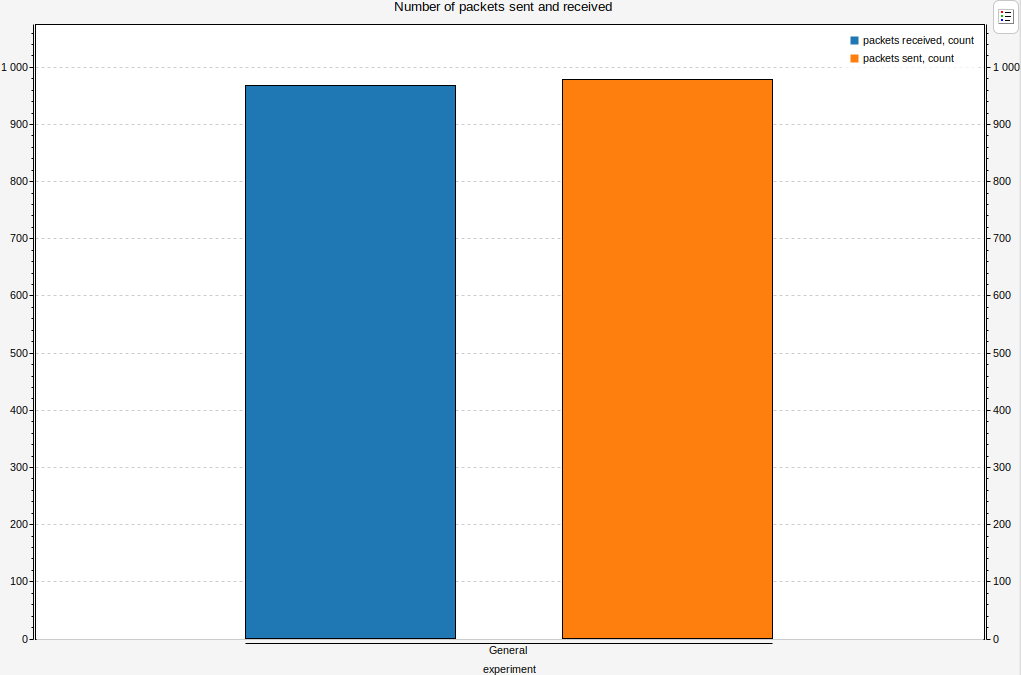
以下是接收和发送的数据包数量:
以下是接收和发送数据包的比例:
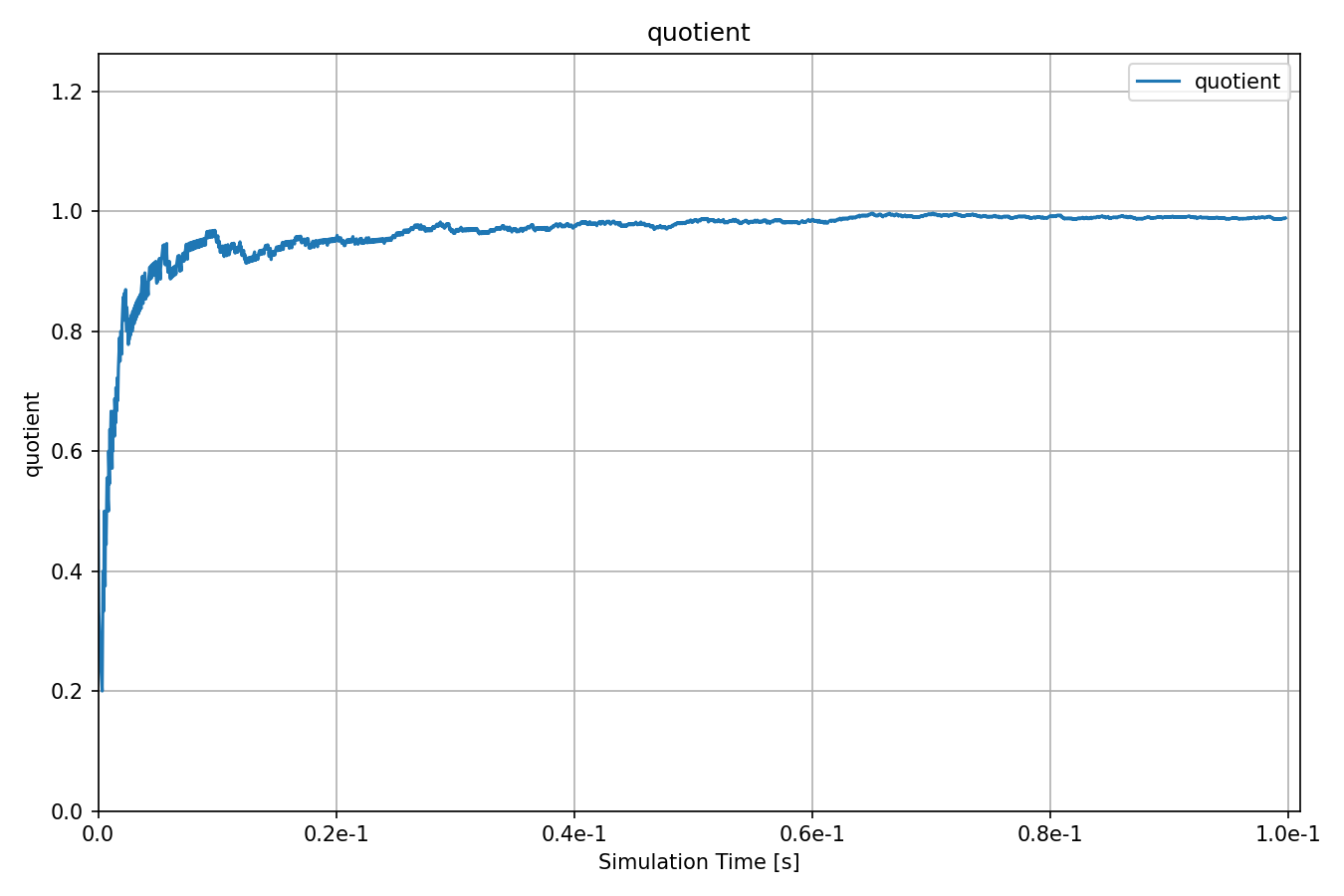
通过python脚本验证了预期成功接收数据包数与发送数据包数之比,预期结果接近1。
以上仿真结果是在0.1s的仿真时间内得到的,在仿真结束时,网络中预设的故障并未生效。若将仿真时间设置得足够长,使得预设的两条链路断开,仍会存在一条有效链路保证成功传输,以下是预设的两条链路断开后的网络拓扑:
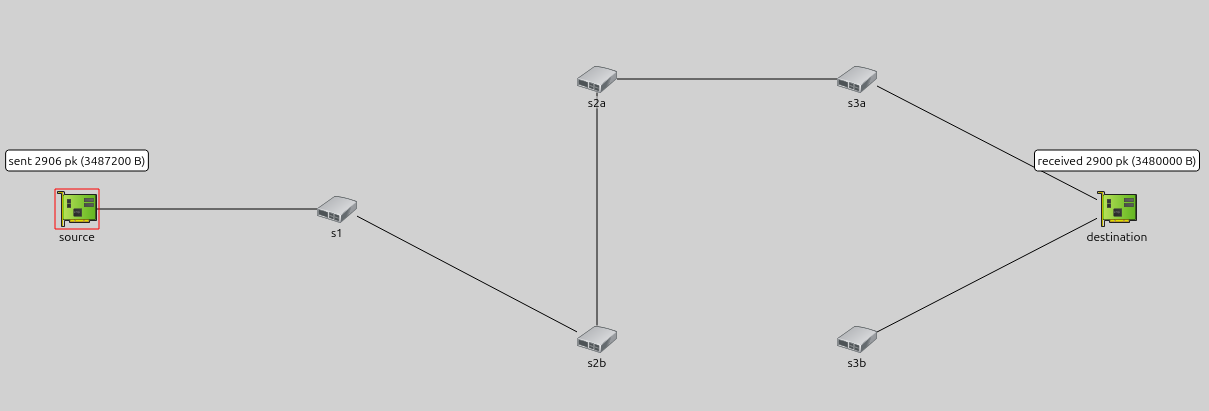
由仿真结果计算得到的成功接收数据包数与发送数据包数之比略小于1,这是因为当仿真结束时,部分数据包仍在网络中传输,并未抵达destination。
讨论
如果您对这个示例有任何疑问或讨论,请在 此页面 分享您的想法。